<–2/”>a >On November 1, 1858, a grand Darbar was held at Allahabad. Here Lord Canning sent forth the royal proclamation which announced that the queen had assumed the government of India. This proclamation declared the future policy of the British Rule in India.
The Queen’s Proclamation of 1858 assured the Indian Princes that their territories will not be annexed by the British Governments and they shall be given the right to adoption. A Durbar was held by Lord Canning at Allahabad on 1st November, 1858 to declare the assumption of the Government of India by the Crown. On that occasion Lord Canning also had read out the Queen’s proclamation to the princes and people of India.
The British Government ordered its servants in India not to interfere in the religious affairs of the Indians. In framing and administering law in India, due regard was to be shown to the customs, ancient rites and usages of the Indians. Indian subjects of Her Majesty were declared equal with the British subjects in other parts of the Empire. Equal rights and opportunities were guaranteed to the Indians along with other British subjects. Pardon and amnesty were offered to all those Indians who were still in arms against the British Government and who were not guilty of murder of British subjects. The treaties of the English East India Company were declared to be in force. The proclamation contained the following declaration about the Indians: “In their prosperity will be our strength, in their contentment our security and in their gratitude our best reward”.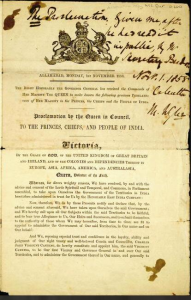
The proclamation of 1858 was a great landmark in the Constitutional History of India. This declaration of policy remained the basis of Indian Administration up to 1917 when a new declaration was made by the British Government with regard to India. The declaration tried to remove the fears of Indian princes by guaranteeing to them their position. It also gave an assurance to the Indians that the Englishmen will not interfere in their religious affairs.
,
The Queen Victoria Proclamation was a proclamation issued by Queen Victoria on November 1, 1858, that marked the end of the East India Company’s rule in India and the beginning of direct British rule. The proclamation also announced the establishment of the British Raj, which would rule India for nearly 100 years.
The proclamation was issued in response to the Indian Rebellion of 1857, which had led to the deaths of thousands of British and Indian people. The rebellion was a major turning point in the history of British India, and it led to a number of changes in the way that India was governed.
The proclamation was designed to reassure the Indian people that the British government was committed to their welfare and that they would be treated fairly under British rule. The proclamation was issued in both English and Urdu, and it was translated into several other Indian languages. It was read aloud in public places throughout India, and it was also printed in newspapers and pamphlets.
The proclamation contained a number of important promises, including the following:
- That all Indians would be equal before the law, regardless of their religion or caste.
- That the British government would respect Indian customs and traditions.
- That the British government would not interfere in Indian religious affairs.
- That the British government would protect the rights of Indian princes and rulers.
The proclamation also announced a number of reforms, including the following:
- The establishment of a new Indian Civil Service, which would be open to Indians as well as British people.
- The creation of a new Indian Legislative Council, which would have some power to make laws for India.
- The introduction of English Education in India.
The Queen Victoria Proclamation was a significant document in the history of India. It marked the end of the East India Company’s rule and the beginning of direct British rule. It also announced a number of important promises and reforms that were designed to improve the lives of the Indian people.
The Indian Rebellion of 1857, also known as the Sepoy Mutiny, was a major uprising against British rule in India. The rebellion began on May 10, 1857, when a group of Indian soldiers, or sepoys, refused to use new cartridges that they believed were greased with animal fat. The sepoys believed that using these cartridges would violate their religious beliefs, and they refused to obey orders to use them. The rebellion quickly spread to other parts of India, and it soon became a major challenge to British rule.
The rebellion was eventually suppressed by the British, but it had a profound impact on the history of India. The rebellion
74.6 75.5c-23.5 6.3-42 24.9-48.3 48.6-11.4 42.9-11.4 132.3-11.4 132.3s0 89.4 11.4 132.3c6.3 23.7 24.8 41.5 48.3 47.8C117.2 448 288 448 288 448s170.8 0 213.4-11.5c23.5-6.3 42-24.2 48.3-47.8 11.4-42.9 11.4-132.3 11.4-132.3s0-89.4-11.4-132.3zm-317.5 213.5V175.2l142.7 81.2-142.7 81.2z"/> Subscribe on YouTube