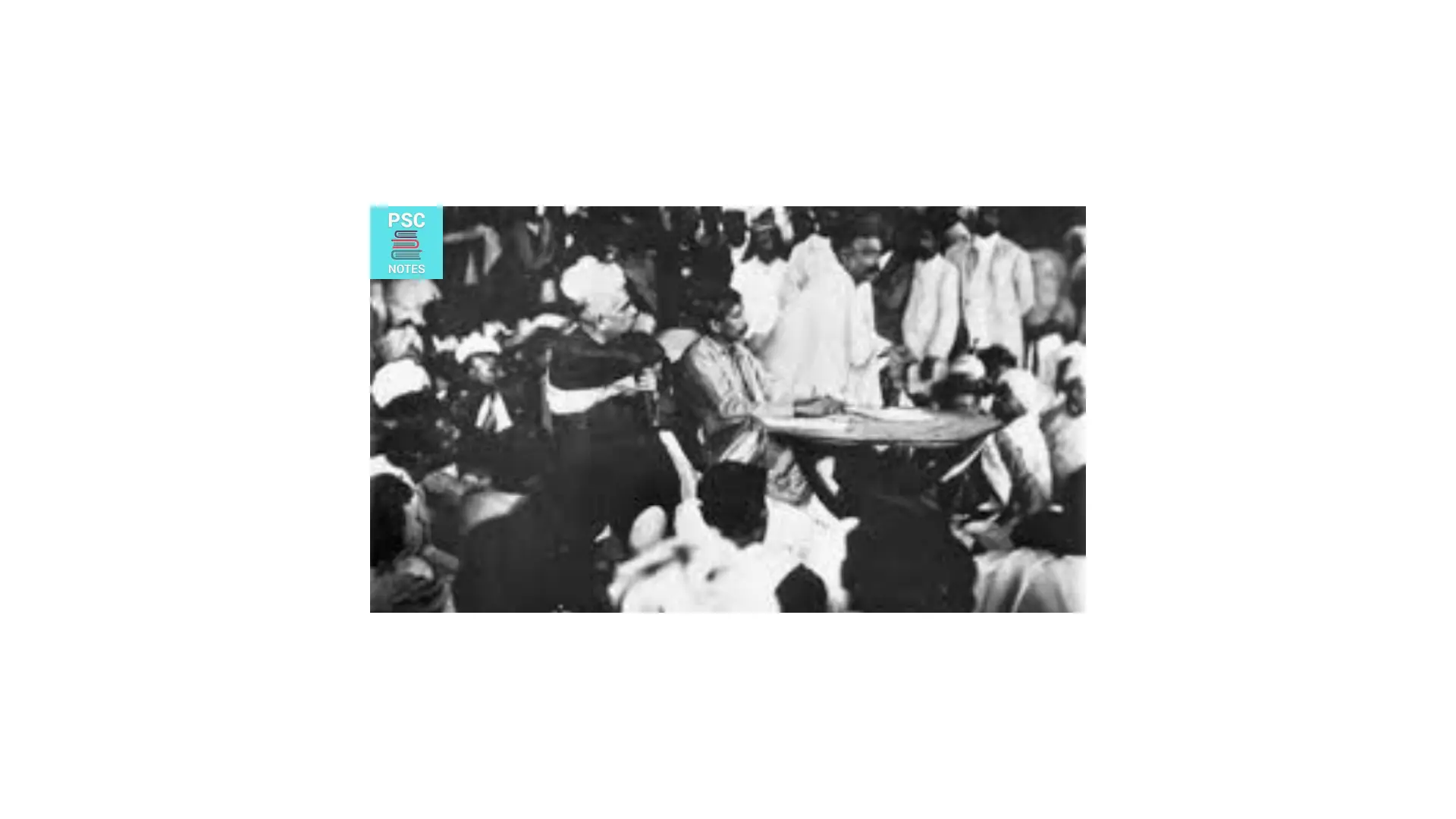
The Split in the Congress: Surat 1907
- Moderates were successful to some extent.
- Moderates failed in many aspects. Why?
- They could not acquire any roots among common people.
- They believed that they could persuade the rulers to change their policies. However, their achievement in this regard was meager.
- They could not keep pace with the events. They failed to meet the demands of the new stage of the national movement.
- The British were keen on finishing the Congress because:
- However moderate the leaders were, they were still nationalists and propagators of anti-colonialist ideas.
- The British felt that moderates led congress could be finished off easily because it did not have a popular base
- In the swadeshi movement, all sections of INC united in opposing the Partition
- However, there was much difference between the moderates and the extremists about the methods and scope of the movement
- The extremists wanted to extend the Swadeshi and Boycott movement from Bengal to the rest of the country and to boycott every form of association with the colonial government
- The moderates wanted to confine the boycott movement to Bengal and even there to limit it to the boycott of foreign goods
- After the Swadeshi movement the British adopted a three pronged approach to deal with congress. Repression-conciliation-suppression.
- The extremists were reppressed
- The moderates were conciliated thus giving them an impression that their further demands would be met if they disassociated from the extremists. The idea was to isolate the extremists.
- Once the moderates and extremists were separate the extremists could be suppressed through the use of state force while the moderates could later be ignored.
- The congress session was held on December 26, 1907 at Surat, on the banks of the river Tapti.
- The extremists wanted a guarantee that the four Calcutta resolutions will be passed.
- They objected to the duly elected president of the year, Rash Behari Ghose.
- There was a confrontation with hurling of chairs and shoes.
- The government launched a massive attack on the extremists. Newspapers were suppressed. Tilak was sent to Mandalay jail for six years.
- The extremists were not able to organize an effective alternative party or to sustain the movement.
- After 1908 the national movement as a whole declined.
- The moderates and the country as a whole were disappointed by the 1909 Minto-Morley reforms
- The number of indirectly elected members of the Imperial and provincial legislative councils was increased.
- Separate electorates for Muslims were introduced.
- With the split of Congress Revolutionary Terrorism rose.
- In 1904 V D Savarkar organized Abhinav Bharat as a secret Society of revolutionaries
- In April 1908, Prafulla Chaki and Khudiram Bose threw a bomb at a carriage which they believed was occupied by Kingsford the unpopular judge at Muzzafarpur.
- Anushilan Samity and Jugantar were two most important revolutionary groups.
- An assessment of the split
- The split did not prove useful to either party
- The British played the game of divide and rule
- To placate the moderates they announced the Morley-Minto reforms which did not satisfy the demands of the nationalists. They also annulled the partition of Bengal in 1911.
The Surat Split of 1907 was a major turning point in the history of the Indian National Congress. The split occurred at the Surat session of the Congress, when a group of younger, more radical members of the party, led by Bal Gangadhar Tilak, clashed with the older, more conservative members, led by Gopal Krishna Gokhale. The split led to the formation of two separate factions within the Congress, the Moderates and the Extremists.
The Background to the Split
The Indian National Congress was founded in 1885 by a group of British-educated Indians who were inspired by the ideals of the British Liberal Party. The early Congress was a moderate organization that sought to achieve self-government for India through constitutional means. However, by the early 1900s, a younger, more radical generation of Indians had emerged who were impatient with the slow pace of reform. These young men, led by Bal Gangadhar Tilak, believed that India could only achieve independence through mass agitation and direct action.
The Surat Split
The Surat Split occurred at the Surat session of the Congress in December 1907. The session was originally scheduled to be held in Calcutta, but the government refused to grant permission for the meeting to be held there. As a result, the Congress was forced to move the session to Surat, a city in Gujarat.
The tension between the Moderates and the Extremists came to a head at the Surat session. The Extremists, led by Tilak, wanted to pass a resolution calling for swaraj, or self-rule. The Moderates, led by Gokhale, opposed the resolution, arguing that it was too radical. The debate over the resolution became increasingly heated, and eventually, the Extremists walked out of the session.
The Aftermath of the Split
The Surat Split had a profound impact on the Indian National Congress. The split led to the formation of two separate factions within the Congress, the Moderates and the Extremists. The Moderates, who were now in the minority, continued to pursue a policy of constitutional reform. The Extremists, on the other hand, adopted a more radical approach, calling for mass agitation and direct action.
The split also had a significant impact on the Indian independence movement. The split weakened the Congress and made it more difficult for the party to achieve its goals. However, the split also helped to
47.8C117.2 448 288 448 288 448s170.8 0 213.4-11.5c23.5-6.3 42-24.2 48.3-47.8 11.4-42.9 11.4-132.3 11.4-132.3s0-89.4-11.4-132.3zm-317.5 213.5V175.2l142.7 81.2-142.7 81.2z"/> Subscribe on YouTube