<<–2/”>a href=”https://exam.pscnotes.com/5653-2/”>p>sectors and segments of a circle, presented in the format you requested:
Introduction
In the realm of geometry, a circleâa simple yet profound shapeâoffers fascinating divisions. Two of the most fundamental divisions are sectors and segments. While both are parts of a circle, they are distinct in their construction and properties.
Key Differences: Sector vs. Segment
| Feature | Sector | Segment |
|---|---|---|
| Definition | A part of a circle enclosed by two radii and their intercepted arc. | A region of a circle bounded by a chord and its corresponding arc. |
| Construction | Formed by cutting a “Pie slice” from the center of the circle. | Formed by cutting a piece away with a straight line (chord). |
| Contains | The circle’s center. | Does not contain the circle’s center (unless the chord is a diameter). |
| Shape | Always a portion of a circular disk. | Can be crescent-shaped or resemble a smaller portion of a disk. |
| Area Calculation | Involves the central angle and the radius. | Involves the central angle, radius, and trigonometry. |
Visual Representation
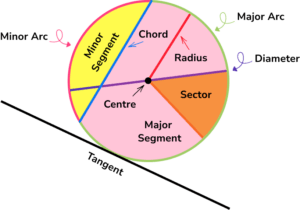
Advantages and Disadvantages
| Sector | Segment | |
|---|---|---|
| Advantages | Easier to visualize and calculate the area. Important for understanding angles and arc lengths. | More flexible in shape. Used in various geometric applications. |
| Disadvantages | Less flexible in shape. Limited by the angle and radius. | Area calculation can be more complex. Not directly related to central angles. |
Similarities
- Both are parts of a circle.
- Both are defined by arcs.
- Both have measurable areas.
FAQs
-
What is the difference between a major and minor sector?
A major sector has a central angle greater than 180 degrees, while a minor sector has a central angle less than 180 degrees. -
Can a segment be a sector?
Yes, a segment becomes a sector if the chord defining the segment is a diameter of the circle. -
What are some real-life applications of sectors and segments?
Sectors: Calculating the area of a pizza slice, understanding clock angles, designing pie charts.
Segments: Engineering (calculating cross-sectional areas), architecture (designing arches), measuring portions of land or bodies of water. -
How do I find the perimeter of a sector or segment?
Sector: Add the lengths of the two radii and the arc length.
Segment: Add the length of the chord and the arc length. -
Are there other ways to divide a circle?
annuli (ring-shaped regions), concentric circles (circles with the same center but different radii), and other shapes using combinations of chords, arcs, and radii.
Yes! Circles can be divided into
Let me know if you’d like a deeper dive into any of these topics or have any other questions!