Holy Dip on Ram Navami: Large numbers of devotees are taking a holy dip in the Saryu River in Ayodhya on the occasion of Ram Navami, highlighting the river’s continued religious significance.
River’s Course: The Saryu originates at Sarmul in Uttarakhand, flows through
the Kumaon Himalayas, and eventually merges with the Sharada (Kali) River at the India-Nepal border. The Sharada then flows into the Ghaghara River, which is
popularly known as Sarayu in its lower course, especially through Ayodhya.
States Traversed: The river flows through the states of Uttarakhand and Uttar Pradesh.
Length: The Saryu is approximately 350-400 kilometers long.
Ayodhya’s Location: Ayodhya, the birthplace of Lord Rama, is situated on the banks of the Saryu River. This location underscores the river’s historical and cultural importance in Hinduism.
Ancient Significance: The river is of ancient significance, finding mentions in the Vedas and the Ramayana. This highlights its long-standing presence in Indian religious and cultural texts.
Massive Antimony Discovery in Pakistan: Pakistan has reportedly discovered a significant antimony deposit in Balochistan.
What is Antimony: A metalloid element (symbol Sb, atomic number 51) that is solid at room temperature with poor electrical and heat conductivity.
Forms of Antimony: Typically found as ingots, broken pieces, granular, or cast cakes.
Occurrence: Found in volcanic rock deposits and deep-seated veins. The primary ore is stibnite. Often obtained as a byproduct of lead-zinc-silver mining.
Major Producer: China is the dominant producer, accounting for 88% of global output. Other producers include Bolivia, Russia, and Tajikistan.
have economic implications for the region. Antimony’s diverse applications across industries make it a strategically important resource. Its use as an alloy to harden lead makes it crucial for industries such as manufacturing batteries for electric cars.
Pakistani Pilgrims Visit: A group of 300 Pakistani citizens of Indian origin from Sindh visited and offered prayers at the Dwarkadhish Temple.
Dwarkadhish Temple Significance: The Dwarkadhish Temple, also known as Jagat Mandir, is a Hindu temple dedicated to Lord Krishna (Dwarkadhish – King of Dwarka).
Char Dham Significance: It’s a part of the Char Dham pilgrimage circuit, one of the most important Hindu pilgrimage circuits in India.
Ancient Origins: The original temple dates back to at least 200 BCE, believed to be built by Vajranabha, Lord Krishna’s great-grandson. Rebuilt in the 16th century.
India’s AI Investment: India ranked 10th globally in private AI investment in 2023, signaling growing engagement in AI development.
UNCTAD Report: The Technology and Innovation Report 2025, released by UNCTAD, focuses on inclusive AI development, particularly for developing countries.
Concentration of Power: A small number of companies (mostly in the US and China) control a significant portion (40%) of global R&D investment, highlighting an uneven playing field.
Global South Exclusion: Many countries (118), primarily in the Global South, are excluded from global AI governance discussions.
Job Displacement Potential: AI could affect up to 40% of global jobs.
Key Leverage Points: Developing countries need to bolster infrastructure, data, and skills to effectively
Readiness for Frontier Technologies Index: India improved its ranking to 36th in 2024 (from 48th in 2022) on the Readiness for Frontier Technologies Index.
Unique Chromosomes: Flowerpot snakes possess three sets of chromosomes (trisomy) instead of the usual two. They have 40 chromosomes, organized into three subgenomes.
DNA Repair Insights: Scientists are studying the snake’s
Delhi Implements Ayushman Bharat: Delhi becomes the 35th State/UT to adopt the Ayushman Bharat Pradhan Mantri Jan Arogya Yojana (AB PM-JAY) on April 5, 2025.
Agreement Signed: An MoU was signed between the National Health Authority (NHA) and
Scheme Benefits: Approximately 36 lakh Delhi residents (around 6.54 lakh families) are expected to benefit, including 6 lakh senior citizens.
Financial Coverage: Beneficiary families will receive ₹5 lakh health cover per year, plus an additional ₹5 lakh top-up from the Delhi government, giving a total of ₹10 Lakh.
Coverage Inclusions: The scheme covers 1,961 medical procedures across 27 specialties, including medicines, diagnostics, hospitalization, ICU care, and surgeries.
Focus on Senior Citizens: All Delhi senior citizens aged 70 and above are covered under Ayushman Vay Vandana Yojana, regardless of socio-economic status with 5 lakh free health cover to all senior citizens of the age 70 years and above irrespective of their socio-economic status.
Card Distribution: Distribution of Ayushman Bharat cards in Delhi will begin on April 10, 2025.
National Impact: AB PM-JAY aims to cover 55+ crore beneficiaries, approximately 40% of India’s vulnerable population and Out-of-pocket expenditure has declined from 62% in 2014 to 38%
Expanded Coverage: The AB PM-JAY scheme includes over 3.6 million frontline health workers, such as ASHAs and Anganwadi workers, and provides them with health and life insurance coverage under the Pradhan Mantri Jeevan Bima Yojana.
joint exercises with all nations, denying the base is exclusively for China.
Chinese Involvement: China provided substantial financial and technical support for the base’s expansion. A Chinese military official, Cao Qingfeng, highlighted the “iron-clad friendship” and future joint military exercises, including Golden Dragon drills.
Strategic Concerns: The base’s location near the Malacca Strait raises concerns about China’s strategic foothold in the Indo-Pacific, potentially encircling India and increasing its naval presence in the South China Sea.
U.S. Concerns: The U.S. fears the base could provide China with
a key strategic position in the Gulf of Thailand and South China Sea.
Geopolitical Reactions: Military representatives from various nations attended the inauguration. Hun Manet confirmed that Chinese President Xi Jinping will visit Cambodia this month.
India’s Concerns: India worries about strategic encirclement and potential disruption to its naval operations in the Indo-Pacific due to a Chinese naval presence at Ream.
Increased Chinese Naval Capabilities: China’s enhanced presence at Ream could challenge India’s interests in the Bay of Bengal and the Indian Ocean Region.
Other Naval Visits: A Japanese warship will be the first to dock at the Ream base. Prior to this, a US warship docked in Sihanoukville, followed by a visit from a senior US army commander.
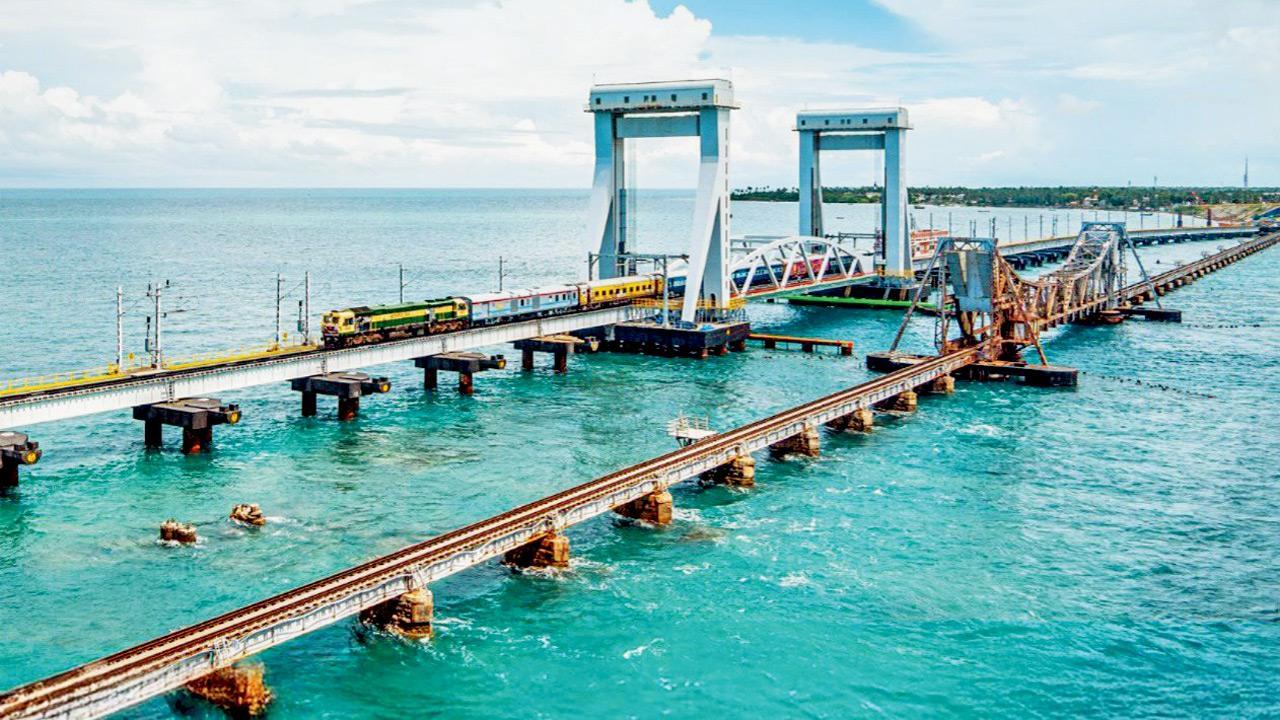
PM Inaugurated New Pamban Bridge: The Prime Minister has inaugurated the upgraded Pamban Rail Bridge (Rameswaram Bridge).
Vertical Lift Span: The new bridge features India’s first vertical lift sea bridge, allowing the central span to lift for ship passage. This provides 22 meters of clearance, up from 19
Faster Train Operations: The upgraded bridge supports double-line electrification, enabling faster train operations between the mainland and Rameswaram Island.
Modernization and Upgrades: The project, started in 2019 and completed by March 2025, modernizes a vital transportation link.
Historical Significance: The original Pamban Bridge, commissioned in 1914, has been a crucial connection for over a century.
Strategic Importance: The bridge facilitates pilgrimage to the Rameswaram Temple and previously served as a route for refugees during the Sri Lankan Civil War.
Old Bridge Preservation: The old Pamban Bridge will be preserved as a heritage structure.
Improved Connectivity: The new bridge enhances connectivity between Rameswaram Island and the mainland, supporting regional and national transportation.
Star-Rating System Introduction: The Ministry of Environment, Forest and Climate Change (MoEF&CC) launched a star-rating system in January 2022 to evaluate State Environmental Impact Assessment Authorities (SEIAAs) based on their efficiency in granting environmental clearances.
Rating Scale & Purpose: Ratings ranged from 0 to 7, incentivizing faster approvals and adherence to timelines. The objective was to promote ease of doing business while maintaining environmental standards.
Opposition and Concerns: The system faced opposition, particularly from the Tamil Nadu Fishermen’s Association, who feared it would compromise the thoroughness of environmental impact assessments. They worried about weakened safeguards and negative impacts on local ecosystems.
Legal Challenge & NGT Intervention: The fishermen’s association challenged the system, leading to intervention by the National Green Tribunal (NGT).
the original Office Memorandum (OM) following the NGT’s order, effectively abandoning the star-rating system. The NGT order noted the ministry had “given up” on the system.
Future Outlook: The ministry may develop a revised memorandum with new criteria at a later date, according to counsel.
Key reason for the withdrawal: The primary driver for