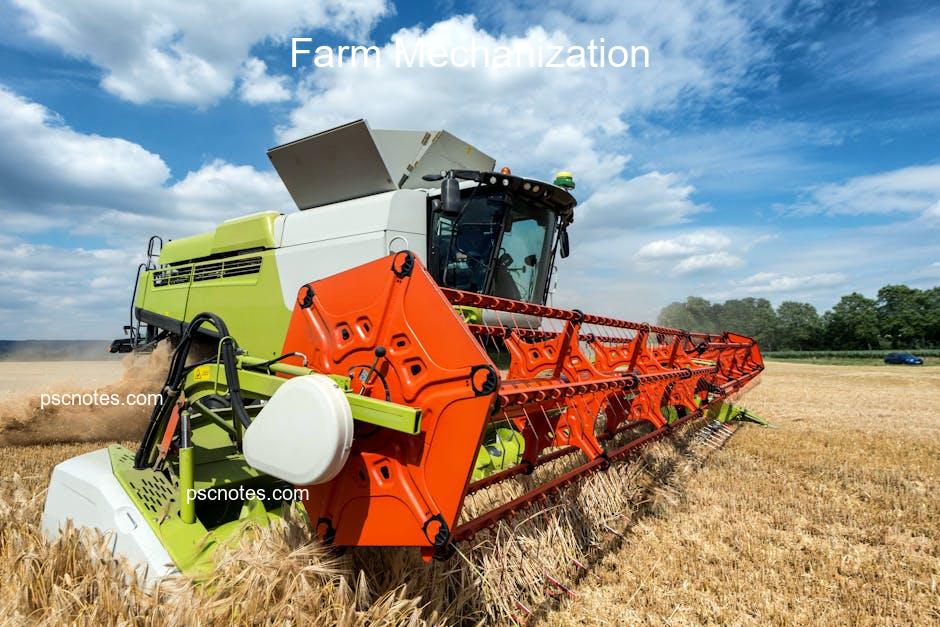
Farm Mechanization
1 year ago
Shift in Focus: India’s farm mechanization is evolving from tractor-dominance to smart machinery, automation, and precision tools.Farm Mechanization Defined: Utilizing machines (harvesters, modern implements) to boost productivity, efficiency, and reduce reliance on manual labor.Emerging Technologies:
Precision Agriculture (GPS, IoT, AI, drones, data analytics for optimized resource use).
Drones (crop monitoring, pesticide spraying, yield estimation; Drone Didi Scheme for women SHGs).
Autonomous Machinery (driverless tractors, robotic harvesters).
Agri Robotics and AI (automation in sowing, irrigation, weeding, harvesting).
Mechanization Levels: Overall ~47% in India. Punjab & Haryana: 40-45%, Northeastern states: negligible. Cereal crops: 50-60%, horticulture: less mechanized.Global Comparison: Developed nations: >90%, underdeveloped regions (Africa, South Asia): manual labor-dependent. China (60%), Brazil (75%) lead among developing nations.Significance:
Input Savings (ICAR): 15–20% on seeds/fertilizers, 5–20% increase in cropping intensity.
Higher Efficiency: improved labor efficiency, 15–20% reduction in operation time.
Efficient Land Utilisation: Advanced tilling tools making hard land arable and mechanised irrigation ensuring efficient water use.
Need for Mechanization:
Rising Food Demand: Population growth, limited land/water, monsoon dependency.
Less Efficient Agriculture: Low GDP contribution despite large workforce.
Labor Shortages: Urbanization, MGNREGA.
Irrigation Challenges: Dependence on rainfed agriculture.
Challenges:
Small Land Holdings: Average 1.16 hectares.
Financial Constraints: High machinery costs.
Poor Equipment Quality: Substandard machinery.
Regional Disparities: Hilly areas, remote regions.
Way Forward:
Land Consolidation & Custom Hiring (CHCs).
Technology & Financial Access (subsidies, low-interest credit).
R&D, Standardization & Training.
Inclusive Mechanization (specialized machinery for diverse regions).
Market Growth: Farm machinery market is growing faster than tractors. Rotavators: a ₹2,000 crore market. Agri machinery market (excluding tractors): >₹10,000 crore.Labor Savings: Combines drastically reduce harvesting time and costs compared to manual labor. Rice transplanters address labor shortages.Custom Hiring Model: Owner-operators providing harvesting/transplanting services to multiple farmers. This model is more sustainable.